This week we're going to switch over to the yang channels and talk about Shaoyang point pairs for moving qi.
So what are these Shaoyang points, and when would we choose them over Jueyin pairs?
The Shaoyang Alternatives to Four Gates
When we talked about Four Gates, we said that this was a very balanced pair—it had one yin point and one yang point. One was the gate of qi, and the other was the gate of blood.
But what if you don't want to be balanced? What if you just want to move qi and dredge the channels?
Well, since movement is a yang function, sometimes it's better to choose points on the yang channels to get things moving.
And that brings us to the Shaoyang channel, and two point pairs in particular:
- GB-34 (Yanglingquan) + SJ-6 (Zhigou)
- GB-41 (Zulinqi) + SJ-5 (Waiguan)
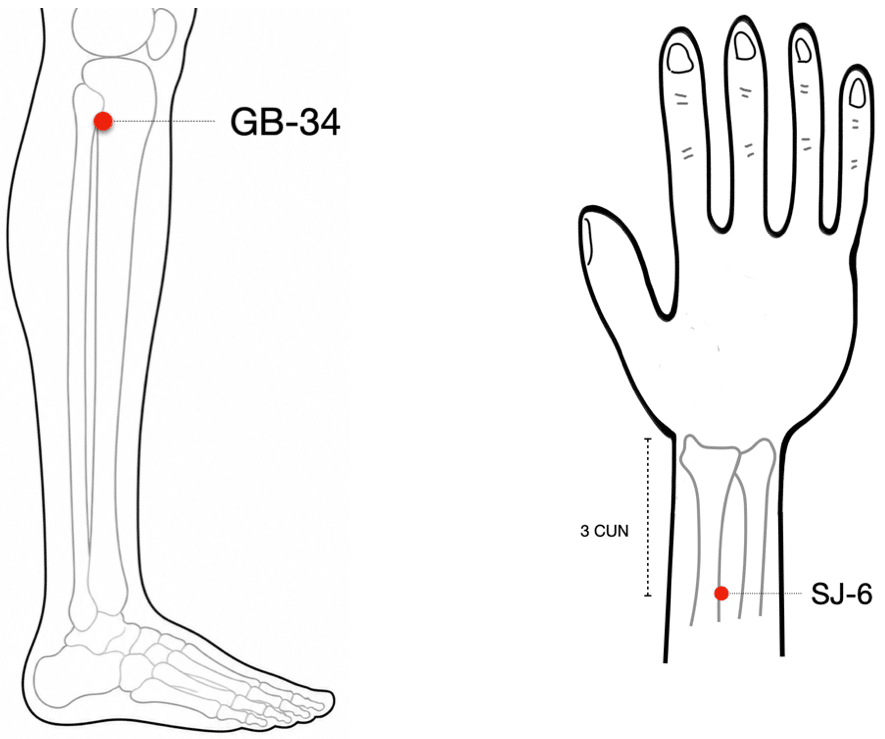
GB-34 (Yanglingquan) + SJ-6 (Zhigou)
This is a same-name channel pair (they're both on the Shaoyang channel), with one point on the leg and one point on the arm.
And this pair can be used to dredge and drain the Shaoyang and strongly move stagnation.
Wang Ju-Yi says:
This pair is useful for constipation or abdominal distension, intercostal pain, sciatic nerve pain, some types of shingles, premenstrual syndrome involving breast tenderness/irritability, and dysmenorrhea.
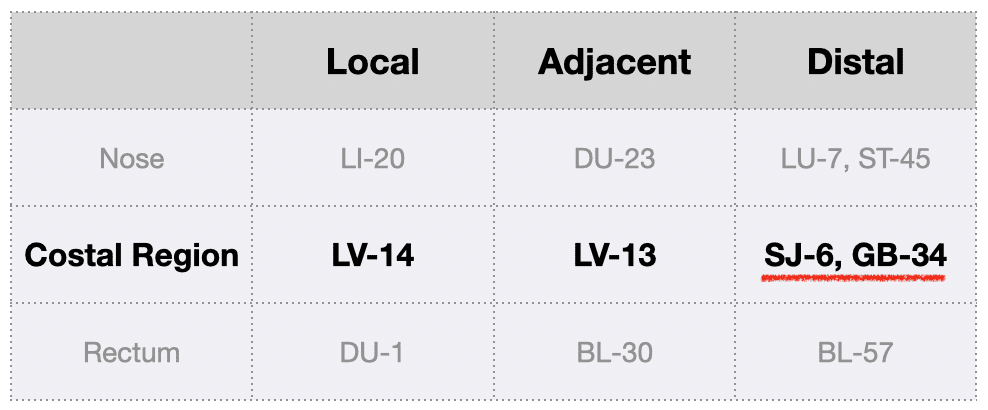
If you remember back to your CAM point pairs, this is a distal combination for the costal region. So that's why so many of these indications reference the trunk and ribside area.
And the classics support this:
The Ode to Elucidate Mysteries says: "For pain of the ribs and lateral costal region needle the Flying Tiger [Feihu, an alternative name for Zhigou SJ-6]."
The Song of Points for Miscellaneous Diseases states: "Pain of the lateral costal region, you only need GB-34 (Yanglingquan)."

For me, I like to include "frequent sighing" under the category of ribs and lateral costal region. When people sigh, they are expanding their ribs in order to pump LV/GB qi through the channels. So if a patient sighs before answering each question (and has other symptoms of qi stagnation), then I might consider GB-34 + SJ-6 as a point combination.

One thing to note about this pair: it's very effective at dredging Shaoyang qi, but it doesn't clear heat.
For that, we would have to go to the next point pair...
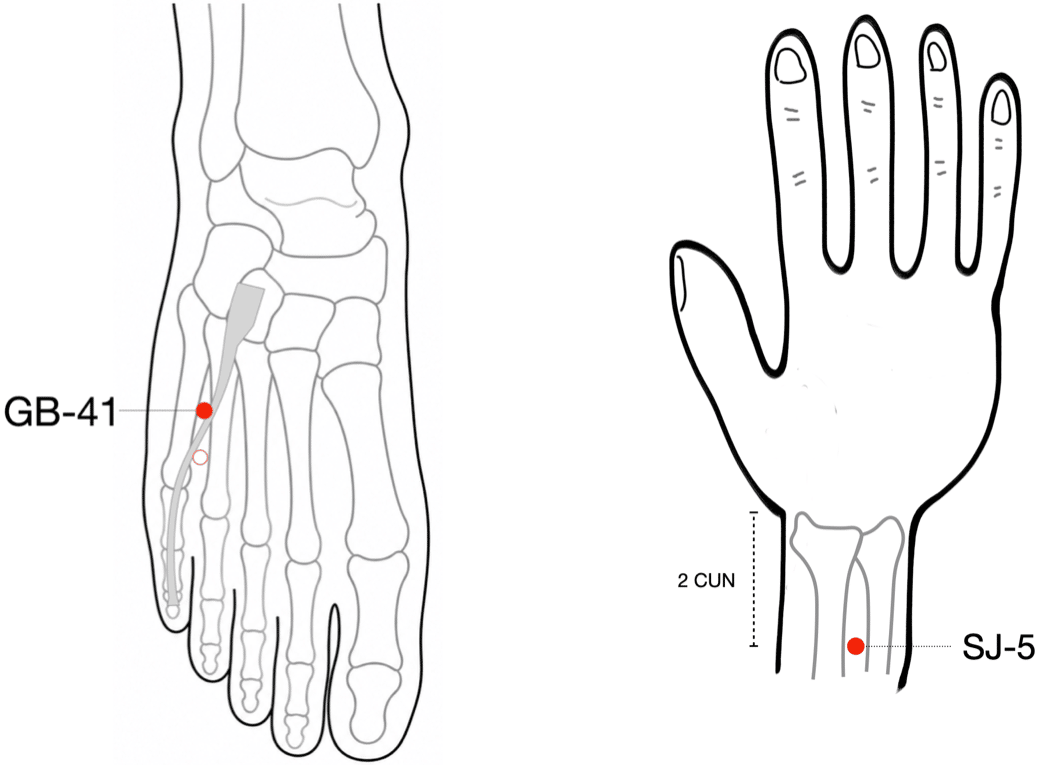
GB-41 (Zulinqi) + SJ-5 (Waiguan)
This is another Shaoyang pair that moves qi, but this one also "clears and drains" the Shaoyang — specifically, excess heat in the channel.
When heat gets in the channel, it often flares upward and causes symptoms in the head and face.
Wang Ju-Yi says this pair can be used for:
...vomiting, headaches, red eyes, nasal congestion, ear ringing, tooth pain, and/or a sense of tightness in the throat. In the clinic this pair is often used for conditions such as tinnitus, conjunctivitis, dry-itchy eyes, dizziness or high blood pressure due to heat rising.

There's a few ways we can think about these points:
- The name of GB-41 is "Foot Governor of Tears", so it's good for the eyes.
- These are the command points of the Yang Wei Mai and the Dai Mai. The Yang Wei Mai travels to the head, making this pair useful for head conditions; the Dai Mai wraps around the waist, so it can also reach lower-jiao issues.
- Points on the hands and feet treat the opposite end of the channel, which is usually the head and face.

And finally, Wang Ju-Yi says that this point pair is good for "pain that occurs along the path of the Shaoyang Channel."
For me, I often have patients coming in with headaches or migraines, and when I ask about location, they point to GB-20 (Fengchi) and then trace the GB channel over the top of their head to the eye. This would be a situation where I would use GB-41 + SJ-5.

How to Pick the Right Pair
So we have all these options for point pairs, but when do we use each one?
Well here are a couple ways I think about it:
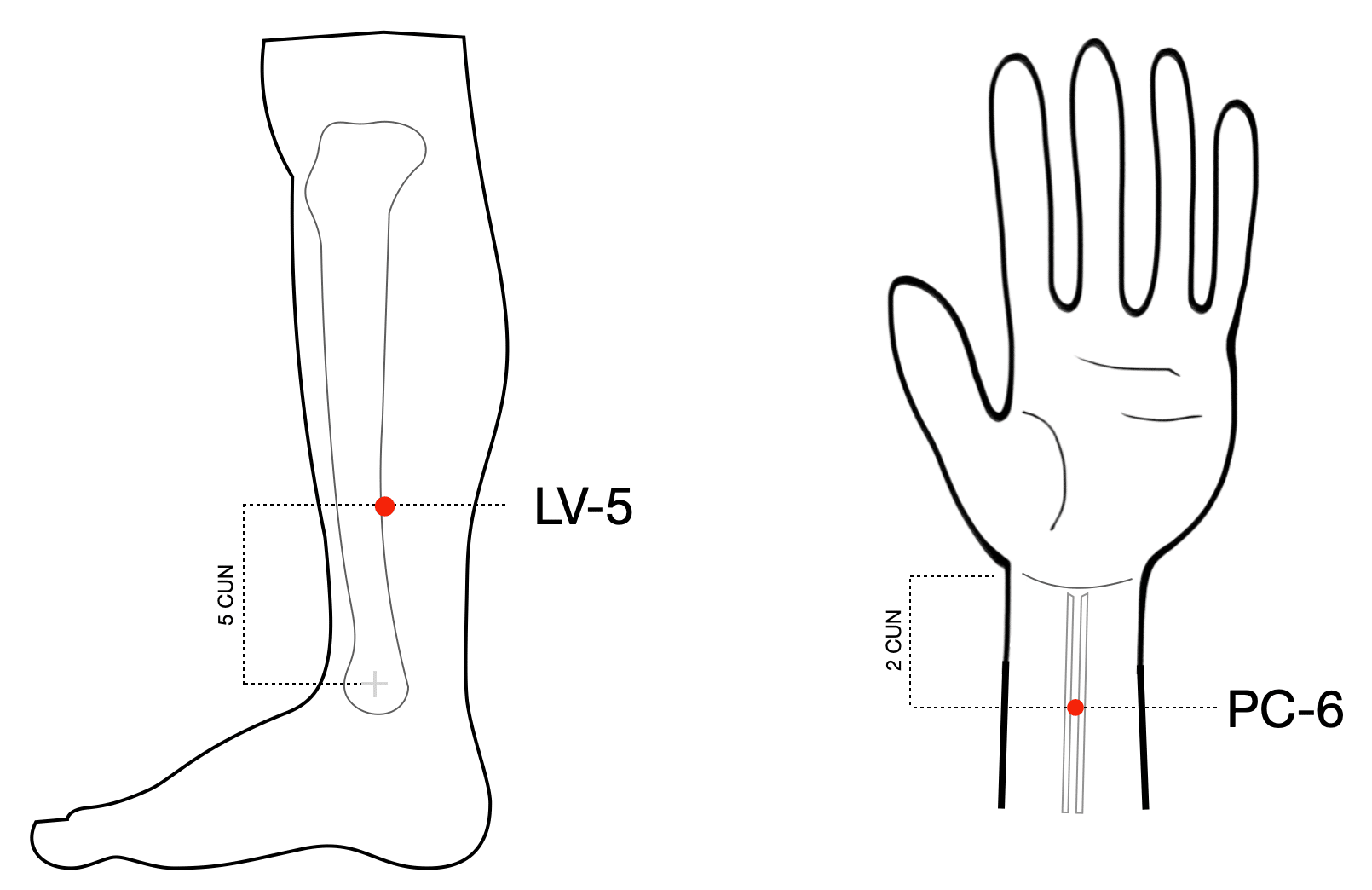
Jueyin vs. Shaoyang
Last time we talked about Jueyin points for moving qi:
- LV-5 (Ligou) + PC-6 (Neiguan)
- LV-2 (Xingjian) + PC-7 (Daling)
And these pairs had a similar heat vs. no-heat distinction.
But when would we use those Jueyin pairs versus these Shaoyang pairs?
Here's one way to break it down: if the patient presents with a yin condition (internal, deficiency, cold) then you might be more inclined to use points on yin channels. If the patient has a yang condition (external, excess, heat) then you might be more likely to use points on yang channels.
So for emotional issues with an element of deficiency, I might be more inclined to use LV-5 + PC-6.
But for things like pain along the channel or qi stagnation without deficiency, I might prefer to use one of these Shaoyang pairs.
(As an herbal metaphor, I would think of LV-5 + PC-6 as being like Xiao Yao San (rambling powder)—it moves but also softens and tonifies. Whereas GB-34 + SJ-6 is more like a Chai Hu Shu Gan San (bupleurum powder to dredge the liver)—it just moves and dredges.)
So if you've decided on a Shaoyang pair, how would you know which one to use?
Heat vs. No Heat
For these Shaoyang points, just ask: "Does this patient have heat or not?"
If you need to dredge the Shaoyang and they also have heat signs, use GB-41 + SJ-5.
If they don't have heat signs and you just want to move, use GB-34 + SJ-6.
Where's the Problem?
You can also look at where the problem shows up.
Points around the knee tend to treat issues of the trunk. So GB-34 + SJ-6 is better for the ribs and costal region.
Whereas points on the feet tend to treat issues in the head and face. So GB-41 + SJ-5 is better for eyes, ears, and headache.
(And there's some overlap here with the heat issue: heat rises. So when you have issues in the head and face, there's often heat in the channel that has risen up to those areas. So GB-41 is also indicated there.)

So what do you think about these pairs? Do you like using Jueyin and Shaoyang points, or would you rather just stick to Four Gates?