It's the season of spring: the flowers are blooming, the bees are buzzing, and the butterflies are reveling in free movement.
But for many people, it's also the season of allergies. That means congestion, sinus problems, and a runny nose.
So let's talk about some overlooked points for treating congestion and runny nose...
Points that Benefit the Nose
If I asked you to pick a point to open the nasal passages, your first choice would probably be LI-20 (Yingxiang) or Bi Tong (M-HM-14).
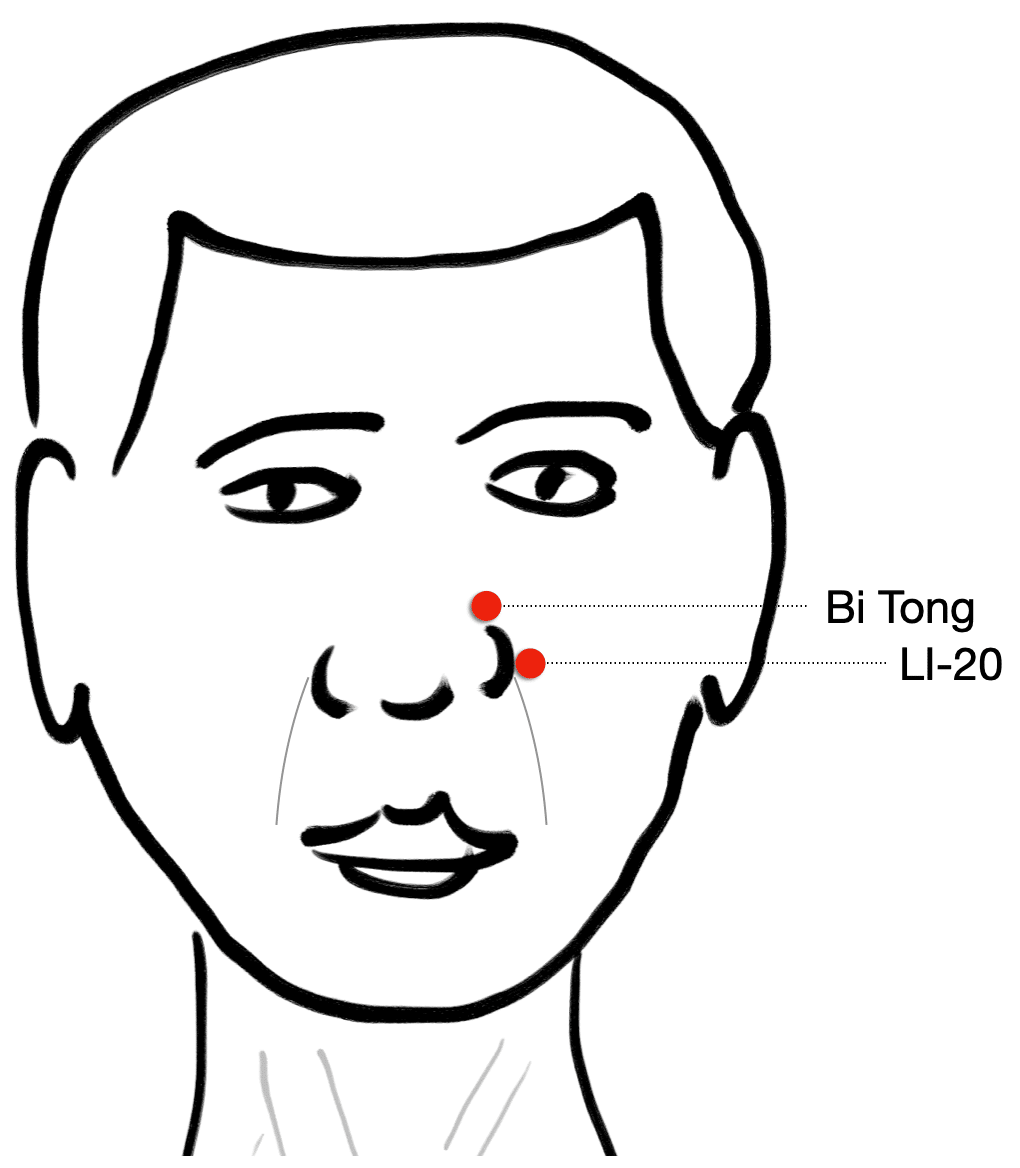
And those aren't wrong. These are local points — they're right next to the nose, so they're good for the nose.
(The name of LI-20 is yíng xiāng (迎香), which means "welcome fragrance", so you know it'll help you smell the flowers. Rather than choosing between the two, most people just thread LI-20 to Bi Tong.)
But it turns out there are less-obvious options that work really well — and a powerful one that often gets overlooked is DU-23 (Shangxing).
Local, Adjacent, and Distal Points
You've probably heard of using a combination of local and distal points to treat a condition.
Local points are right next to (or on top of) the affected area, while distal points are farther away (usually on the extremities). But the book Chinese Acupuncture and Moxibustion lists a third category that's kind of in between the two: adjacent points.
Adjacent points are not right on top of the affected area, but they're still in the general vicinity.
(These can be especially useful when you don't want to needle right into the affected area, like infections, wounds, and hemorrhoids.)

So for opening the nose:
- LI-20 and Bi Tong are local points
- LU-7 and LI-4 are distal points
- DU-23 is an adjacent point
Even though DU-23 is on top of the head (within the hairline), the fact that it's directly above the nose makes it useful for treating nasal conditions.
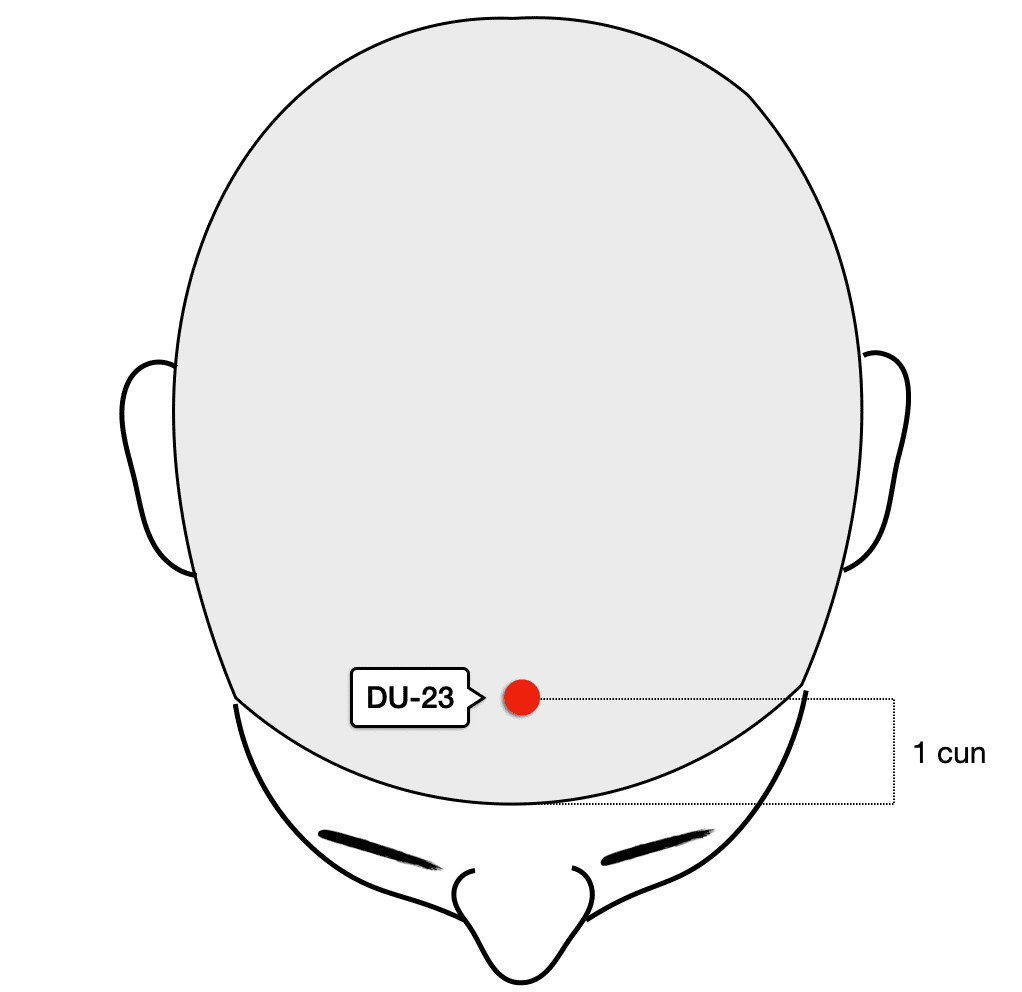
According to Deadman, DU-23 is indicated for: nasal obstruction and discharge, inability to distinguish the fragrant from the foul (loss of smell), rhinitis, and ceaseless bleeding from the nose.
Maciocia includes it in his prescriptions for allergic rhinitis, sinusitis, and external attacks of wind-cold. He typically recommends needling it downward toward the nose in these cases.
And my friend Patrick uses DU-23 as a key point for loss of smell after COVID infection.

The Third Eye
Another adjacent point you might not think of for benefitting the nose is Yin Tang (M-HN-3).
Most people use Yin Tang as their go-to point for calming the spirit and treating anxiety, but they forget that it can also be used for local conditions like headache and nasal congestion.
This one also shows up in Maciocia's point prescriptions for allergic rhinitis.
Maciocia's Prescriptions for Seasonal Allergies
When treating allergic rhinitis (seasonal allergies), Maciocia likes to split the treatment up into root and branch.
For treating branch symptoms, he has two patterns: wind-cold and wind-heat. Wind-cold has more symptoms of profuse runny nose, while wind-heat includes symptoms like scratchy throat and itchy-red eyes.
- Wind-Cold: BL-12, BL-13, LU-7, LI-20, Bi Tong, Du-23, GB-20, Yin Tang
- Wind-Heat: BL-12, BL-13, LI-4, LI-11, LI-20, Bi Tong, Yin Tang, GB-20

When the patient is experiencing symptoms, treat the branch. But once the symptoms have resolved, switch to treating the root cause so that they don't come back.
To do that, Maciocia recommends tonifying the Lung and Kidney's Wei qi systems and strengthening the Du Mai. This should be done outside of pollen season towards the end of summer and beginning of autumn.
- Root Treatment: DU-4, REN-4, BL-23, KI-3, BL-13, DU-12, DU-24, DU-23, GB-20, DU-14, SI-3, BL-62
So you can see that DU-23 and Yin Tang are scattered amongst the various patterns to expel wind from the nose and stop nasal discharge.

Herbal Remedies
And if you're interested in an herbal approach to seasonal allergies, you might want to check out this newsletter article that I wrote last year about the formula Bi Yan Pian.